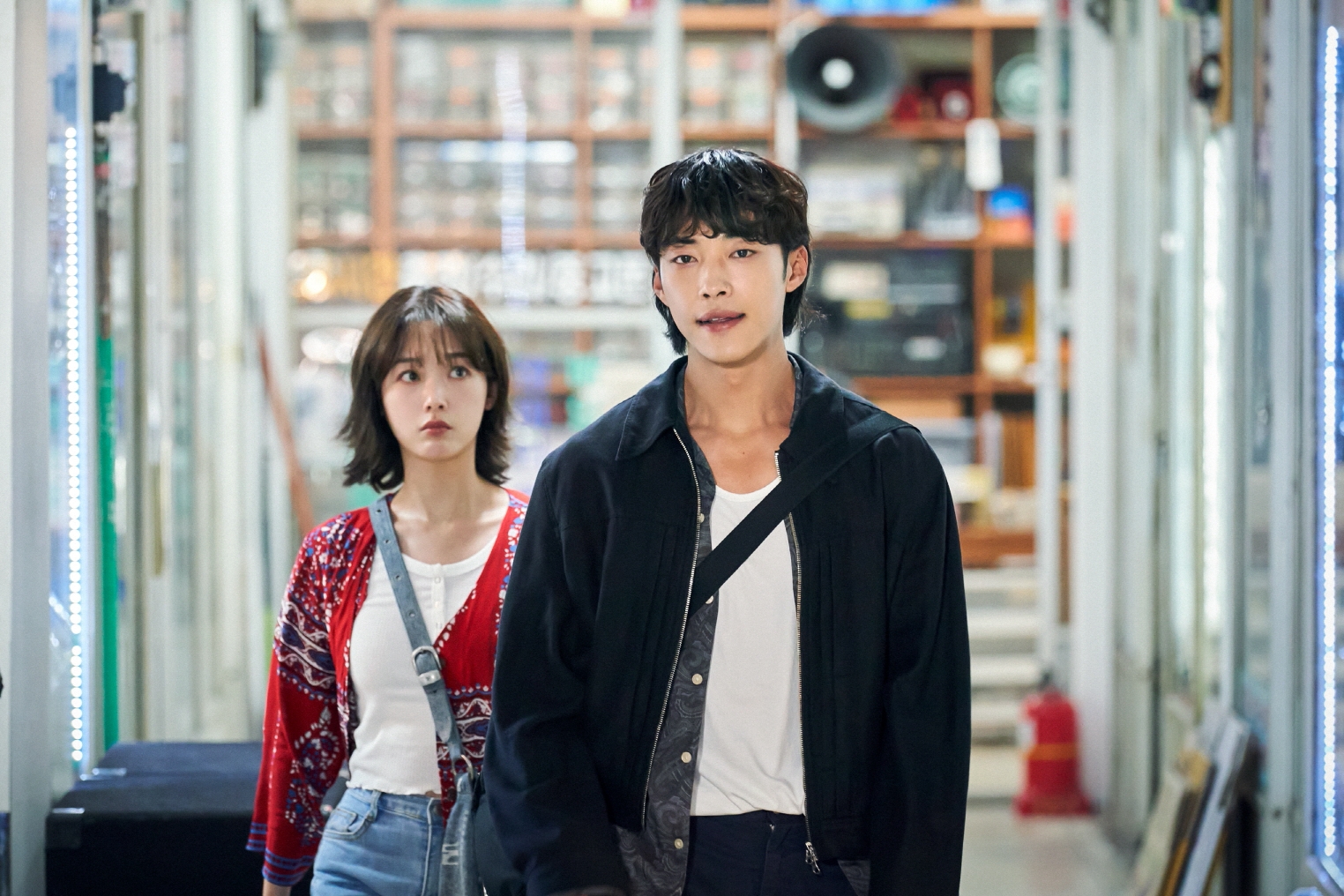
Credit: Netflix
Can we really say that Netflix’s new series Mr. Plankton is really a comedy? The tear-jerking 10-episode drama is filled with plenty of hilarious scenes but the overall message of the terminally ill protagonist’s story will truly leave you in tears at the end of practically every episode.
Mr. Plankton is a romantic comedy about two unlucky souls—Hae Cho ( Woo Do Hwan ), a man burdened by bad luck and a terminal illness leaving him little time to live. He was abandoned by his family after discovering he was the by-product of someone else’s artificial insemination specimen and not his actual father’s – leading him to live life as a drifter. Jaemi ( Lee Yoo Mi ) is a woman who desperately wants to be a mother but is struggling with unexpected life changes just before her wedding. By an odd turn of events and an unexpectedly hilarious kidnapping, Jaemi is forced to accompany Hae Cho’s final journey in search of his father.
The story isn’t the ordinary formula for a K-Drama and that is what makes it quite the refreshing end-of-the-year binge if you feel tired of some other romantic storylines. There are a plethora of humorous characters introduced into the story – each with their amusing perspectives, unique quirks, and heartfelt storylines. From meeting the unluckiest woman in the world whom Hae Cho fondly calls his “jackpot” to meeting a momma’s boy soon-to-be husband of Jaemi who turns from enemy to beloved companion by the end of the series – each character has a well-written story that is cohesive to Hae Cho’s unique journey.
The show is filled with a lot of slap-stick and physical humor which Korea was well-known for in the early 2000s and up till now. However, the real jokes lie in the puns behind the characters’ names, shops, etc. For example, Hae Cho sounds like “Hae-jwo” which means do something for others in Korean. Jaemi sounds similar to “funny” and even one man named John Na” sounds similar to a slang term for f–k. If you don’t speak Korean, a lot of these wonderful subtle jokes may go unnoticed. Overall, the comedy does contain a lot of “Korean humor” making foreign viewers possibly tilt their heads in confusion at times but, fortunately, the subtitles are well-made and fully convey the story’s many antics and gags.

Credit: Netflix
Woo Do Hwan Reflects on the Emotional Toll of Playing a Terminal Character in ‘Mr. Plankton’
Judging from the title alone, one wouldn’t expect Mr. Plankton to convey such a critical storyline in a show littered with happy-go-lucky musings and moments. Director Hong Jong Chan, known for hit dramas like Juvenile Justice, and writer of It’s Okay to Not Be Okay , have a remarkable sense of cinematography as well as verbal poetry. All comical, adrenaline pumping, and sullen scenes are pleasantly conveyed from the camerawork and the dialogue is well-spoken, with the meaning being clear and not forcing the viewers to read between the lines per se. The opening scene comes full circle with the final episode showing Hae Cho collapsed, dying in the snow as Jaemi rushes over to him. In the beginning, it looks as if she is the one ready to kill him but towards the end you can feel Jaemi is running out of desperation and fear wishing Hae Cho didn’t have to die that way because she would rather kill him instead.
During an interview regarding the hardships of the character and impactful storyline, Woo Do Hwan said, “The phrase ‘born by mistake’ really fits him. No one wanted him to be born, and he grew up feeling like he was something that should be erased or forgotten…He just drifts around like a plankton, doing only what he finds amusing, like a wanderer.”
In the end, Mr. Plankton is a powerful reminder of how we, like Hae Cho, can still maintain our zest for life even through the most trying of times. There are things that kick us down and spiral into something worse, but isn’t there something everyone feels is worth living and fighting for? (8/10)
